How to Blacken Ash Wood: Rubio Monocoat on a Turned Bowl
There’s something quietly confident about ash. It doesn’t shout with wild figure or exotic coloration. Instead, it speaks in bold, architectural lines—grain patterns that read like topographical maps, each ring telling the story of a season’s growth. This bowl exists because sometimes the most powerful statements are made in contrast.
The Design & Technique
This piece was turned from a single blank of ash, oriented to showcase the wood’s natural linear grain running across the vessel’s face. The form follows a classic profile: a generous, open rim that draws the eye inward, walls that taper with intention, and a foot that grounds the piece without competing for attention.
The Finish: Rubio Monocoat, Two Ways
The defining characteristic of this piece is the dual-finish treatment:
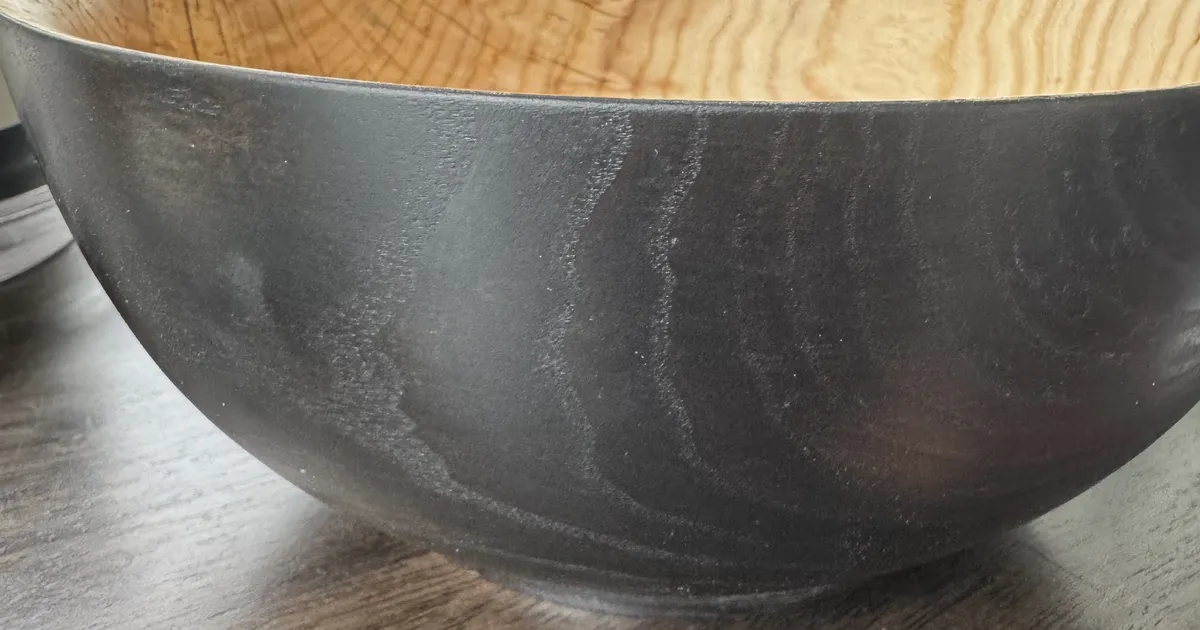
Exterior: Rubio Monocoat Black — a pigmented hardwax oil that penetrates the ash’s open pores, creating a deep, matte black surface that still allows the grain texture to read through. Unlike torch-blackening or ebonizing, Rubio Black is a single-coat application that cures to a durable, furniture-grade finish. It’s modern, architectural, and unforgiving of flaws — which is exactly the point.
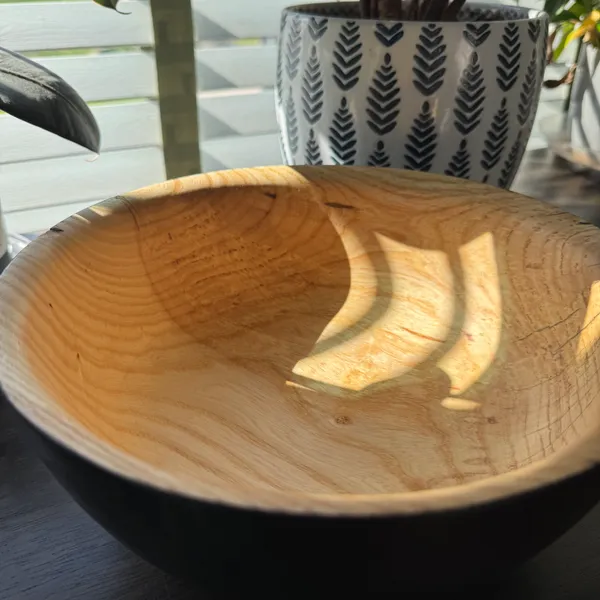
Interior: Rubio Monocoat Pure — the natural, unpigmented version that enhances ash’s inherent warm tones without adding color. The contrast between the blackened exterior and the honey-toned interior creates a visual tension that draws the eye inward, like looking into a vessel carved from midnight itself.
This dual-finish approach requires careful masking and sequential application — the interior must be finished first, protected, then the exterior treated. Any bleed or overlap would compromise the crisp boundary. The result is a piece that feels both grounded and elevated.
How to Blacken Ash Wood: The Process
Ash takes Rubio Monocoat Black exceptionally well because of its open grain structure — the pigment settles into the pores rather than sitting on the surface, which is what gives the finish its depth and texture. Here’s how the dual-finish process works:
Turn and sand to final grit. Ash sands cleanly, but surface prep matters more with a dark pigment finish — scratches show as slightly darker lines in the cured surface. Work through the grits; don’t skip.
Finish the interior first. Apply Rubio Monocoat Pure to the interior and allow it to cure for at least 24 hours. This is the step that can’t be undone: once the exterior is blackened, the boundary is set.
Mask the rim edge. A clean line between the black exterior and the natural interior is what makes the dual-finish work visually. Painter’s tape along the rim gives you a crisp, resolved boundary.
Apply Rubio Monocoat Black — one coat only. Rubio is a single-coat system. Apply with a cloth, work it into the grain across the full surface, then wipe off all excess within 3–5 minutes. You don’t build coats with Rubio — one thorough application is the finish.
Cure for 24 hours before handling. Rubio sets quickly but needs time to harden fully. The surface feels dry well before the finish has fully cured.
The result: a finish that looks like black wood, not painted wood. The grain texture reads through the pigment, the matte surface doesn’t compete with the form, and the contrast between the dark exterior and the warm ash interior creates something that holds attention without announcing itself.
The Material: Ash (Fraxinus species)
Ash has been a turner’s wood for generations, and for good reason:
- Grain structure: Open-pored with prominent, straight grain patterns that create bold visual movement
- Color palette: Ranges from creamy white sapwood to light brown heartwood, often with subtle olive or gray undertones
- Working properties: Machines cleanly, holds detail well, and accepts finishes beautifully
- With Rubio: Ash’s open grain takes Rubio Monocoat exceptionally well — the oil penetrates deeply, and the black pigment settles into the pore structure, enhancing texture rather than hiding it
This particular blank showed consistent grain spacing—no wild figure, no spalting, just honest wood that rewards straightforward craftsmanship. The Rubio Black finish transforms what could be a “plain” piece of ash into something architectural and contemporary.
Specifications
| Dimensions | 9” diameter × 4” height |
| Wood Species | Ash (Fraxinus species) |
| Finish | Rubio Monocoat Black (exterior), Rubio Monocoat Pure (interior) |
| Mounting | Faceplate turning, reversed for foot shaping |
| Edition | 1-of-1 Original |
The Form
The profile is deliberately restrained. The rim flows into the walls without interruption, creating a continuous curve that feels both organic and engineered. The foot is proportioned to allow the bowl to sit securely while minimizing visual weight—this piece is meant to be held, examined, and used, not just displayed on a pedestal.
The interior was left with subtle tool marks visible under direct light—a reminder of the human hand behind the form, not a flaw to be sanded away.
Availability
Architectural Vessel — Blackened Ash is available now.
→ Purchase at shop.turningbytes.com
Frequently Asked Questions
What is blackened ash wood?
Blackened ash is ash wood treated with a dark pigmented finish — in this case, Rubio Monocoat Black, a hardwax oil. Unlike torch ebonizing (which chars the surface) or dye-based staining, Rubio Black penetrates the wood’s open pores and cures to a durable, matte surface that still allows the grain texture to read through. The look is architectural rather than painted.
How do you blacken ash wood?
The most controllable method for turned ash is Rubio Monocoat Black — a single-coat pigmented hardwax oil. Sand the surface thoroughly, apply with a cloth, work it into the grain, and wipe off excess within 3–5 minutes. One coat is all you need. Alternatives include torch ebonizing (more variable, harder to control on curved surfaces) and fumed finishing (which relies on tannin content and works less reliably on ash than on oak).
Is Rubio Monocoat Black food safe?
No — the pigmented version of Rubio Monocoat is not food safe and is intended for decorative and furniture applications. Rubio Monocoat Pure (the unpigmented version) is food safe once cured, which is why I use it on bowl interiors. A piece with a blackened exterior and Pure interior is food safe on the inside and decorative on the outside.
How does Rubio Monocoat Black differ from torch ebonizing?
Torch ebonizing chars the surface and raises the grain texture dramatically — striking but fragile, requiring a sealer to protect the charred layer. Rubio Monocoat Black penetrates the wood and cures to a hardwax finish with no additional sealing required. It’s more durable, more controllable on curved surfaces, and produces a smoother result better suited to a functional object.
Explore More
The dual-finish technique on this piece — Rubio Monocoat Black outside, Pure inside — is one of the more involved finishing processes I use. Wood Bowl Finishes Explained → covers Rubio and the other finishes in my rotation.
See how ash compares to cherry, maple, and walnut: Wood Species Guide →
Browse all my ash turning projects →
Interested in a custom piece with similar character?
I take a limited number of commissions each month to ensure every piece receives the attention it deserves. Let's discuss your custom commission